·Tashkent, Uzbekistan
CityScreen at TAF!26 in Tashkent: proof of play and audience measurement in DOOH
At TAF!26 in Tashkent, Ilyas Salikhov of CityScreen explained how DOOH media owners can prove that ads ran and show advertisers who saw them.
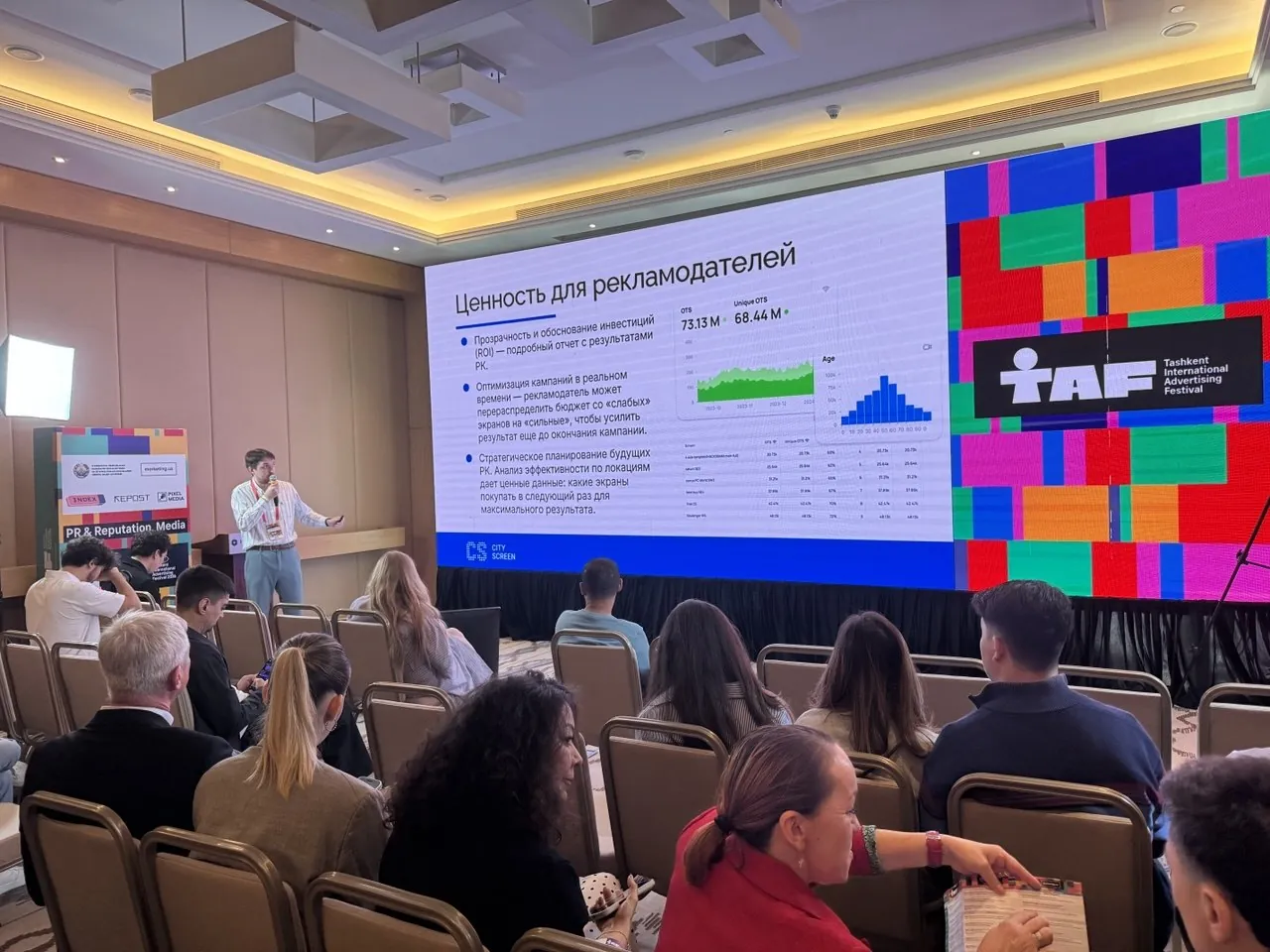
Ilyas Salikhov, Chief Product Officer of CityScreen, spoke at the Tashkent Advertising Festival TAF!26 on 10 October 2026. The Marketing Association of Uzbekistan and the Committee for the Development of Competition and Protection of Consumer Rights organise the festival, and its conference ran in 7 sections at the Hyatt Regency Tashkent. His talk «Transparency in Out-of-Home Advertising: Verification and Measurement» was part of the PR, Reputation & Media section, and later the same day he joined the section’s panel discussion on audience measurement and targeting in OOH (programme).
The talk argued that DOOH is ceasing to be a black box for advertisers. Its line of reasoning follows below. The slides are available as a PDF (14 pages).

Why advertisers ask for proof
The talk named 3 trends behind the change: advertisers win more and more customers through digital channels, they fight for the effectiveness of their advertising, and measurement technology has become better and cheaper. As a result, every advertiser now wants evidence, and in DOOH that evidence has to answer 2 questions: did the ad run, and who saw it.
Did the ad run?
Proof of play answers the first question. In the talk, it rests on 3 sources of data:
- the ad play log;
- automatic photos of the screen during the ad play;
- the post-campaign report.
According to the talk, an advertiser can trust this data when it is kept in a protected cloud, when the playback software is closed to tampering and when every action is logged. The talk added that the most sceptical advertisers also pay external services to audit delivery, and the slide named Admetrix, Seedooh and Veridooh as examples.
Who saw it?
The talk compared 3 ways to measure the audience of DOOH advertising:
- Hyperlocal analytics with Wi-Fi sensors and cameras tracks the people near the screen. Its data is tied to the place and its context and is highly detailed. Its coverage is limited to the sensor’s range.
- Mobile operator data follows subscribers as their phones move between cell towers. It covers a whole city or district and shows movement between large zones. It cannot be tied to a particular screen, its figures are averages over a large area, and it arrives with a long delay.
- Data from mobile app SDKs follows the users of specific apps who gave their consent. It provides behavioural profiles, such as interests and purchases, and allows retargeting. Its sample is limited, so it is hard to say how well it represents the whole audience.
To measure the audience of a particular screen, the talk relied on hyperlocal analytics and its 2 tools:
- A Wi-Fi sensor measures quantity: it counts unique users and produces lists of MAC addresses. It cannot describe who these people are, its data has to be cleaned of stationary devices, and it has to approximate phones that randomise their MAC addresses.
- A camera measures quality: it detects faces and the glances people direct at the screen. It cannot count unique people, and its recognition models need extra training for each set of conditions.
The talk presented the 2 tools together as the pillars of measurement at the screen.
From the screen to the store and to online ads
The talk showed that the MAC addresses collected near a screen can be used beyond the report. On its slide, a hashed export of unique MAC addresses feeds 2 uses: an audience for retargeting in an online ad platform, and offline conversions, illustrated with a photo of a store entrance.
What media owners and advertisers get
For media owners, the talk argued, transparent reporting and analytics make a screen network an asset that they can manage and sell at a higher price:
- prices backed by an objective assessment of each screen, and a higher average deal value;
- control over the network’s profitability, because underperforming sites become visible;
- an edge over competitors and access to new advertisers, because detailed analytics is a strong selling point when budgets are at stake.
For advertisers, the talk listed 3 gains:
- a detailed report on campaign results, which justifies the investment;
- optimisation while the campaign runs: the advertiser can move budget from weak screens to strong ones before the campaign ends;
- better planning of the next campaigns, because results by location show which screens to buy next time.
The talk concluded that DOOH is becoming a data-driven industry: market demands and new technology have made analytics a necessity, and media owners now have the tools to manage the performance of their screens and to give clients results that are transparent, measurable and as close to reality as possible.
Proof and audience data in CityScreen products
CityScreen software gives a media owner both kinds of evidence from the talk:
- CS Play logs every ad play with its date and time, campaign, ad, duration, screen and frame. The media owner can export the log as CSV or XLSX, or send the advertiser a public link to the campaign statistics, which opens without a CS Play account and shows no prices.
- Where a CS Play CamGrabber camera watches the screen, CS Play photographs it during the ad plays chosen in the photo-report schedule or in the campaign settings. The CSV and XLSX exports carry a link to each photo next to its play record, and the media owner can download the photos of a campaign as a ZIP archive. Photos of the media owner’s own campaigns, by schedule or for every play of a campaign, need a paid CamGrabber licence.
- CS EdgeInsights, now in beta, counts the audience at the screen. A Wi-Fi sensor counts the devices nearby and leaves out the ones that stay for long periods, such as staff phones. Where a camera is installed, computer vision counts the people in the screen’s viewing area. The count appears as OTS next to each ad play in the statistics and in every export, so the advertiser’s report shows the audience.
- CS Play exports the unique MAC addresses detected near the screens as plain or MD5-hashed lists, also broken down by frame. The MD5-hashed lists are meant for sharing audience data with third parties.
- CS Context can set floor prices per 1,000 OTS. The audience estimate travels with each programmatic request, and the media owner sets the price per 1,000 OTS, so a request with a larger audience gets a higher floor price.
About CityScreen
CityScreen builds software for DOOH operators: content management, ad sales, programmatic exchange and audience analytics — one stack, run by the operator, not by an agency.